
A hot air balloon has three main parts: the envelope (the big fabric bag that holds the hot air), the burner (which heats that air) and the basket (where the pilot and passengers ride). Several key systems complete it: the fuel cylinders that feed the burner, the parachute vent at the top that lets the balloon descend, the mouth and skirt, the load tapes, the cables and karabiners that hold everything together, and the flight instruments: altimeter, variometer, envelope temperature gauge, radio and GPS.
Below is a labelled diagram, followed by each part explained: what it is made of, what it does and how they all work together in flight.
EnvelopeBurnerBasketParachuteCylindersInstruments
Part 1 · The part that flies
The envelope
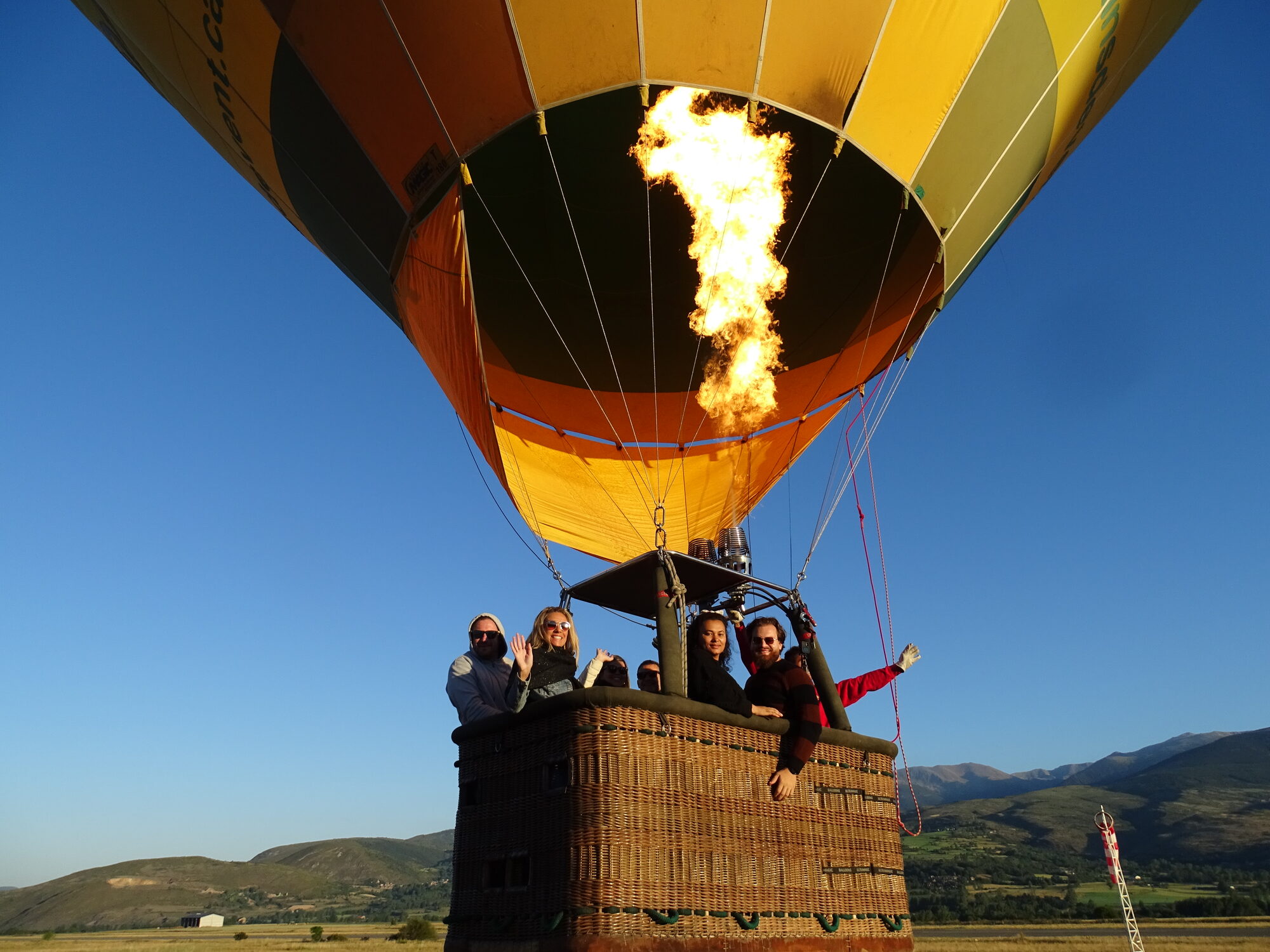
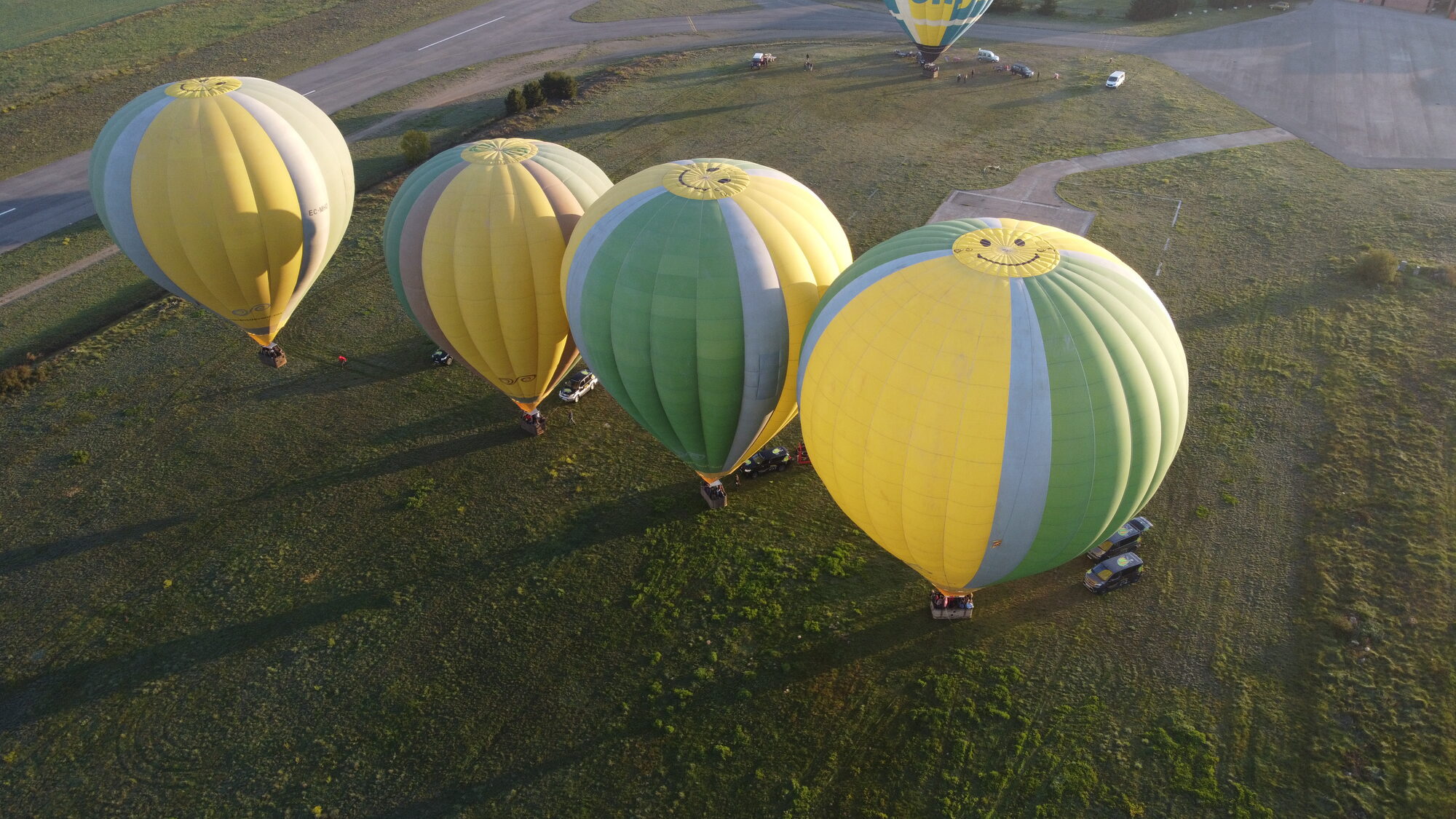
The envelope is the big fabric bag that holds the hot air, and it is the part that actually flies: air that is hotter than the air outside weighs less than the air it displaces, so the balloon rises.
It is sewn from long vertical sections called gores, in coated rip-stop nylon (or polyester): light, almost airtight and woven so that a small tear cannot spread. Size is measured in cubic metres, from around 2,000–3,000 m³ for a small sport balloon to more than 10,000 m³ for the largest passenger balloons. More volume means more lift.
Load tapes
Strong webbing tapes run down the seams, from a crown ring at the top to the steel cables at the bottom, spreading the weight of the basket and passengers across the whole envelope.
Mouth and skirt
The opening at the bottom is the mouth, where the flame goes in. The panels around it are made of fire-resistant fabric (usually Nomex), and many balloons add a skirt (or scoop) to shield the flame from the wind.
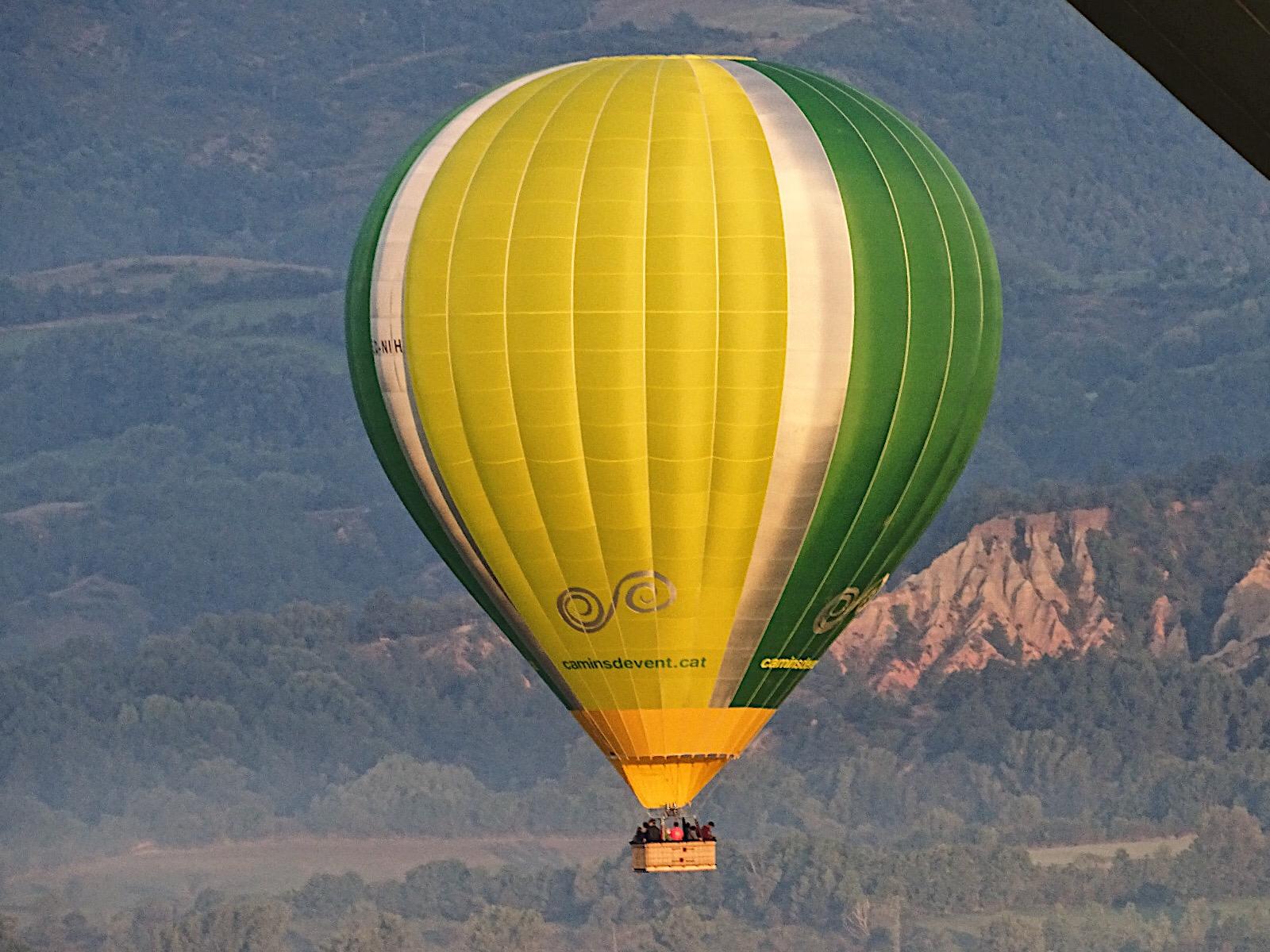
In one sentence: the envelope is the nylon bag that holds the hot air and makes the balloon fly.
Part 2 · The engine
The burner
The burner is the balloon's engine: it heats the air in the envelope. Mounted on a metal frame above the pilot's head, it fires a flame several metres long into the mouth, with the roar everyone remembers from a balloon ride.
Liquid propane from the cylinders passes through a coil wrapped around the flame, where it heats up and turns to gas for a strong, steady burn. A small pilot light stays lit throughout the flight.
Passenger balloons carry two or more independent burners for redundancy. Many also have a quieter liquid-fire (or whisper) valve, used over livestock so as not to scare the animals; its brighter flame is the star of night-glow shows. The pilot burns in short bursts: more to climb, just enough to hold altitude.
In one sentence: the burner heats the air in the envelope with a propane flame.
Part 3 · Where you ride
The basket
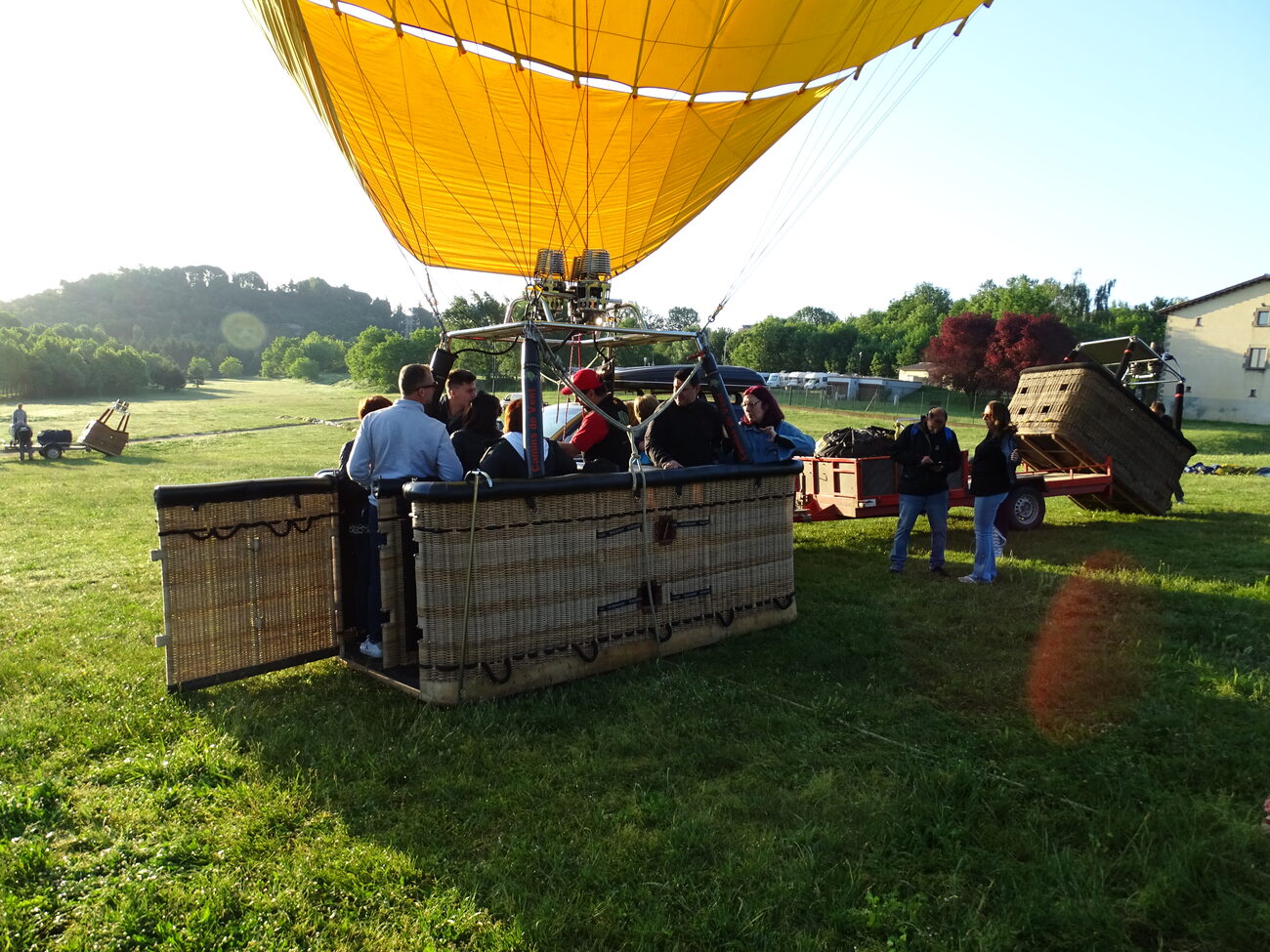
The basket carries the pilot, the passengers and the fuel. It is still made by hand from woven wicker or rattan around a steel frame, with a plywood floor and a padded leather rim. Why wicker today? It is light, strong and flexible: on landing the weave gives a little and absorbs part of the impact.
Baskets range from a single pilot to around 30 passengers; large ones are split into compartments, with the pilot and cylinders in the middle. A passenger basket is about 1.2 m tall, you stand for the whole flight, and some have a side door for easier boarding.
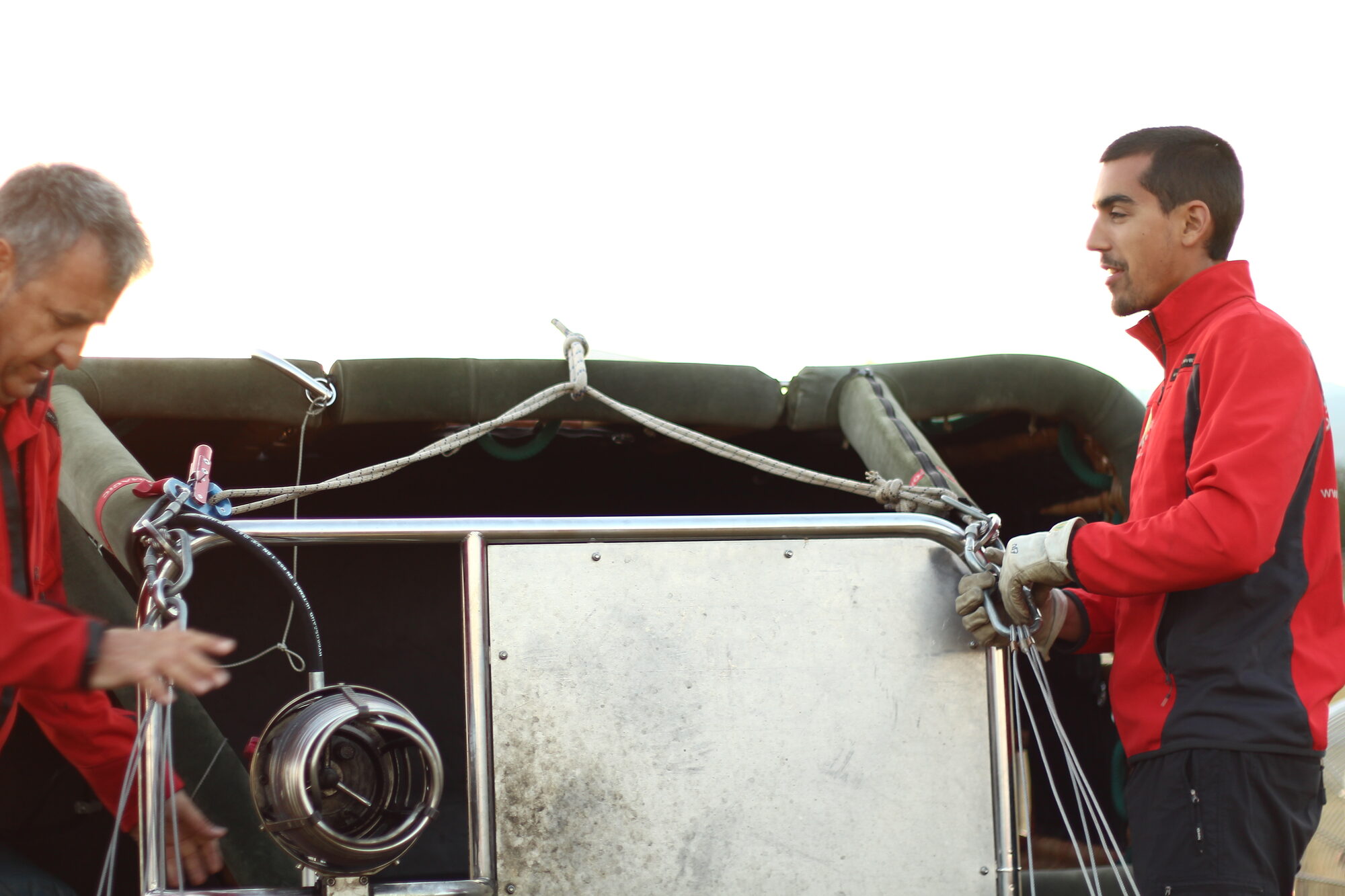
Cables and karabiners: what joins the basket to the envelope
The basket is not tied to the fabric. Stainless-steel cables from the bottom of the envelope clip onto the burner frame with large karabiners, and the basket cables hang from the same frame and run under the floor. The load travels up the cables to the load tapes.
In one sentence: the basket carries people and fuel, and it is made of wicker because it cushions the landing.
Standing in one is another story: at the end we tell you where to do it in Catalonia.
System 1 · Coming down
The parachute vent
The parachute brings the balloon down. It is not for jumping: it is a circular fabric valve at the crown, the very top of the envelope, held shut from the inside by the pressure of the hot air.
When the pilot pulls its line (usually red), the parachute lifts away from the edge, hot air escapes and the balloon descends; let go, and it closes again. On landing it is opened fully to empty the envelope. Many passenger balloons also have side turning vents to rotate the balloon, for example to land with the long side of the basket forward.
In one sentence: the parachute is the valve at the crown; opening it lets hot air out and the balloon comes down.
System 2 · Fuel
The fuel cylinders
Propane travels inside the basket in upright, strapped-in cylinders (or tanks) of stainless steel, aluminium or titanium. Stored as a liquid under pressure, it takes up little space and releases a lot of heat per kilo. Each cylinder has valves, a contents gauge and a hose to the burner, and the pilot can switch between them mid-flight, always keeping a reserve.
In one sentence: the cylinders hold the liquid propane that feeds the burner.
System 3 · Information
The instruments
There is no cockpit, but there is a small instrument panel within the pilot's view:
- Altimeter: altitude.
- Variometer: rate of climb or descent; vital, because a balloon reacts to each burn with a delay.
- Envelope temperature gauge: a sensor near the top keeps the pilot below the manufacturer's limit.
- Fuel gauges on each cylinder.
- Radio: air traffic control when needed, and the ground crew following by car.
- GPS: position, track and ground speed.
A fire extinguisher, a first-aid kit and spare igniters complete the kit.
In one sentence: altitude, climb or descent, envelope temperature and fuel: what the pilot keeps an eye on.
Summary table: what each part is made of and what it does
All the parts at a glance:
| Part | Made of | What it does |
|---|---|---|
| Envelope | Coated rip-stop nylon or polyester | Holds the hot air that lifts the balloon |
| Load tapes | High-strength webbing | Spread the weight across the envelope |
| Mouth and skirt | Fire-resistant fabric (Nomex) | Let the flame in and shield it from the wind |
| Parachute vent | Envelope fabric and lines | Releases hot air to descend and empties the envelope on landing |
| Burner | Stainless steel, coil and valves | Heats the air in the envelope |
| Fuel cylinders | Stainless steel, aluminium or titanium | Store the liquid propane |
| Cables and karabiners | Stainless steel | Join the envelope, burner and basket |
| Basket | Wicker or rattan on a steel frame, plywood floor | Carries the pilot, passengers and fuel |
| Instruments | Electronics and sensors | Report altitude, climb or descent, temperature and fuel |
How the parts work together in a flight
No part works alone. This is how they come into play, from the trailer to the packed-up bag:
1Lay out and rig
The envelope is spread on the ground, the basket laid on its side and the cables clipped to the burner frame.
Key part: cables and karabiners
2Cold inflation
A powerful fan fills the envelope with cold air while the crew holds the mouth open.
Key part: envelope and mouth
3Hot inflation
The burner fires into the mouth: the envelope rises and the basket stands up, still tied to a vehicle.
Key part: burner and skirt
4Take-off
Passengers aboard, a few longer burns, a glance at the variometer, and the tether is released.
Key part: burner and variometer
5In the air
Short burns to hold altitude; the parachute opened briefly to drop into another wind layer.
Key part: parachute and instruments
6Landing and pack-up
The parachute is opened fully, the envelope empties and is folded back into its bag.
Key part: parachute and basket
From diagram to sky
Want to see these parts for real? Fly over Catalonia
Camins de Vent has been organising balloon flights for more than 20 years, with EASA-certified pilots. We fly in six areas: Anoia, Osona, Bages, Cerdanya, the Costa Brava and the province of Lleida.
- About 1 hour in the air and roughly 3 hours for the whole experience.
- Cava toast, flight diploma and photos.
- Open-date ticket valid for 365 days, so you can pick the day once your trip to Catalonia is planned.
- If the weather is not right, we give you a new date at no cost.
Weekday flight: 159 € per person · Premium flight, any day: 179 € per person
Hot air balloon parts: frequently asked questions
What are the parts of a hot air balloon?
The envelope, the burner and the basket, plus the parachute vent, fuel cylinders, mouth and skirt, load tapes, cables and karabiners, and the flight instruments.
What is a hot air balloon basket made of?
Hand-woven wicker or rattan around a steel frame, with a plywood floor. Wicker is light, strong and flexible, so it cushions the landing.
What fuel does a hot air balloon burner use?
Propane, carried as a liquid in cylinders inside the basket.
How hot is the air inside a hot air balloon?
In flight it is typically around 100 °C (about 212 °F) near the top of the envelope, depending on the load and the outside temperature. Manufacturers set a maximum, usually around 120 °C (about 250 °F), and a sensor warns the pilot.
How big is a hot air balloon envelope?
A small sport balloon is about 2,000–3,000 m³ and the largest passenger balloons exceed 10,000 m³. Inflated, a passenger balloon easily stands more than 20 metres tall.


